Commercial Heat Pumps for Hotels and Resorts: Capacity Planning and System Design
Hotels and resorts consume domestic hot water at rates that dwarf residential demand — a 200-room property can use 40,000 litres of hot water every day. For decades, gas boilers and electric immersion heaters have carried that load, but rising energy prices, carbon mandates, and corporate sustainability targets are pushing hospitality operators toward heat pump technology. This guide from Suoher's engineering team walks through the demand calculation, system sizing, cascade design, and specification decisions you need to make when replacing boiler plants with commercial heat pump hot water systems.
Hotel Hot Water: The Demand Problem
Hot water in hotels is not a steady-state load. It is a series of sharp peaks driven by guest behaviour — the morning shower rush (6:00–9:00), housekeeping laundry cycles (10:00–14:00), and evening bathing (19:00–22:00). Between these peaks, demand drops to near zero. The sizing challenge is not average daily consumption; it is peak-hour delivery combined with a storage strategy that bridges one peak to the next.
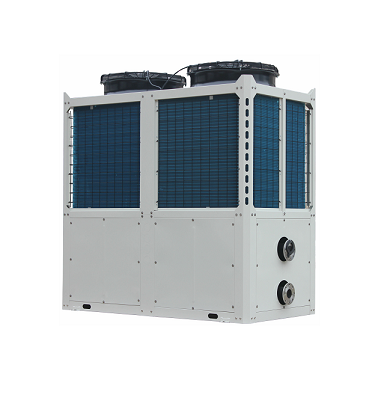
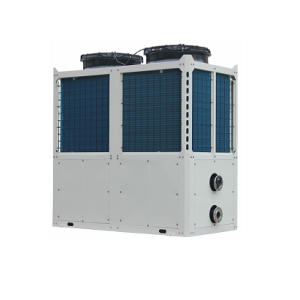
The image above shows the Suoher SHAW-90CV, a 90 kW vertical commercial heat pump designed for modular cascade installation in hotel and resort plant rooms.
Peak Demand Patterns
The ASHRAE Handbook — HVAC Applications (Chapter 50, Service Water Heating) provides per-fixture and per-unit flow rates that engineers use to build a demand profile. For hotels, the critical metric is the maximum probable simultaneous draw: the peak hour where the most rooms are showering, laundry is running, and kitchen operations are in full swing.
A 200-room business hotel typically sees the following daily demand profile:
- Morning peak (6:00–9:00): 60% of rooms showering within 90 minutes — approximately 12,000 L in the peak hour
- Housekeeping (10:00–14:00): 5,000–8,000 L spread across midday for laundry and room cleaning
- Kitchen and F&B: 3,000–5,000 L per meal period, with lunch and dinner both drawing simultaneously
- Evening peak (19:00–22:00): 40% of rooms showering — approximately 8,000 L in the peak hour
The morning peak dominates. Your heat pump system must recover the stored volume before the next peak arrives, or the tank runs cold and guest complaints follow within minutes.
ASHRAE Hot Water Demand Estimation
ASHRAE's per-room method assigns a daily hot water demand based on hotel class and occupancy pattern. The table below consolidates values from ASHRAE Handbook — HVAC Applications and European hotel engineering practice:
| Hotel Class | Daily Demand per Room (L) | Usage Factor | Peak Hour Fraction |
|---|---|---|---|
| Full-service hotel | 250–350 | 0.70 | 30% |
| Resort hotel | 300–400 | 0.65 | 25% |
| Business hotel | 200–250 | 0.75 | 30% |
| Budget / economy | 150–200 | 0.80 | 35% |
For a 200-room resort hotel at 350 L/room/day: 200 × 350 = 70,000 L/day total. At a usage factor of 0.65, the design-day demand is 70,000 × 0.65 = 45,500 L. The peak hour at 25% of daily total means the system must deliver 11,375 L during the highest-demand hour. This is the number that drives heat pump capacity and tank sizing — not the daily average.
Sizing Commercial Hot Water Systems
Sizing involves three interdependent variables: heat pump heating capacity, storage tank volume, and recovery rate. Get one wrong and the system either costs too much upfront or fails to meet peak demand on the coldest morning of the year.
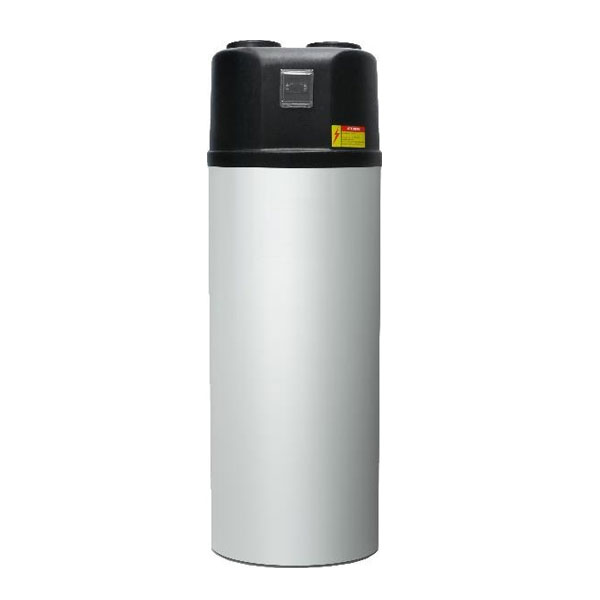
The Suoher SHWW-3T500 — a 500 L heat pump water heater with stainless steel 304 inner liner, shown above — illustrates the storage tank concept. In commercial hotel projects, multiple units or larger custom tanks are deployed.
Rooms × Usage Factor
Start with the room count and daily per-room demand, then apply the usage factor. For a 150-room business hotel:
- Daily demand: 150 rooms × 230 L = 34,500 L
- Design day (× 0.75 usage factor): 25,875 L
- Peak hour (× 0.30): 7,760 L
The heat pump must be able to heat 7,760 L from 10°C mains temperature to 55°C setpoint in one hour. The energy required is:
Q = V × ΔT × 4.18 = 7,760 × 45 × 4.18 = 1,459,576 kJ ≈ 405 kWh
Without any storage buffer, you would need 405 kW of heat pump capacity — enormous and prohibitively expensive. This is where storage strategy changes the economics entirely.
Storage Tank Strategy
A well-sized buffer tank lets you decouple heat pump capacity from peak demand. Instead of installing 400 kW of heat pumps, you install 100–150 kW of heat pump capacity and a 5,000–8,000 L storage tank that pre-heats during off-peak hours when demand is low and electricity may be cheaper.
The storage ratio (tank volume ÷ daily demand) for hotels is typically 0.15–0.25. For our 25,875 L design day:
Tank size: 25,875 × 0.20 ≈ 5,000 L
The heat pump heats the tank continuously at approximately 100 kW. Over a 6-hour off-peak window (22:00–4:00), it delivers 100 kW × 6 h = 600 kWh of thermal energy, enough to raise 5,000 L of water by approximately 28°C. Starting from a mains temperature of 10°C, the tank reaches 38°C before the morning peak — and the heat pump continues running during the peak to top it up to the 55°C setpoint.
Recovery Rate
Recovery rate is the time needed to reheat the tank from the post-peak temperature back to the setpoint. With 100 kW of heat pump capacity and a 5,000 L tank after the morning peak has drawn it down to 25°C:
Reheat energy: 5,000 × 30 × 4.18 = 627,000 kJ ≈ 174 kWh
Recovery time: 174 kWh ÷ 100 kW ≈ 1.7 hours
That fits comfortably between the morning peak ending at 9:00 and the housekeeping load starting at 10:00. If recovery time exceeds the gap between peaks, you need more heat pump capacity or a larger tank — or both. This is the iterative loop that defines commercial hot water system design.
Cascade (Multi-Unit) Heat Pump Systems
A single 90 kW heat pump cannot serve a 200-room hotel — and even if it could, putting all eggs in one basket means zero redundancy. Cascade systems connect multiple heat pump units in parallel, sharing a common flow-and-return header and a master controller that orchestrates staging and load sharing.
Why Cascade
The cascade architecture delivers four engineering advantages that matter for hospitality projects:
- Redundancy: if one unit fails, the remaining units continue to cover 70–80% of the load. Guest complaints are avoided and maintenance can be scheduled rather than rushed.
- Partial-load efficiency: at 30% load, running one inverter unit at full capacity is more efficient than running three units at 10% each. The controller stages units in and out to keep each running near its peak efficiency point.
- Scalability: start with two units, add a third when the hotel expands or adds a spa wing. The header and controls are pre-plumbed for future capacity.
- Serviceability: isolate and service one unit while others stay online. No need to shut down the entire hot water system during maintenance.
Suoher's SHAW-90CV is designed for exactly this architecture — modular vertical units with RS485 communication built in, so a building management system can orchestrate up to 16 units in a master-slave cascade without external controllers. Each unit carries built-in Wi-Fi for remote monitoring and fault alerts.
Controls and Load Sharing
The master controller rotates the lead unit on a schedule (typically every 24–48 hours) to equalize compressor run-hours across the fleet. During low-demand periods, only the lead unit runs. As demand rises and the tank temperature drops below the stage-in differential, the controller brings in additional units one by one. Each unit's internal inverter further modulates capacity between 25% and 120% of rated output, creating a smooth capacity curve from 22.5 kW to 540 kW across a six-unit cascade.
The key control parameters that the commissioning engineer sets on site:
| Parameter | Typical Setting | Purpose |
|---|---|---|
| Lead-lag rotation interval | 24 h | Equalize wear across all units |
| Stage-in differential | 5°C below setpoint | Add a unit when demand rises |
| Stage-out differential | 2°C above setpoint | Drop a unit when demand falls |
| Minimum run time per stage | 10 min | Prevent short-cycling and compressor damage |
Suoher SHAW-90CV — 90 kW Commercial Heat Pump
- Heating capacity: 90 kW
- Power supply: 380V / 3-phase
- Built-in Wi-Fi + RS485 for cascade control
- Modular vertical design for multi-unit cascade
Vertical commercial air source heat pump with strong heating capacity, modular installation, and RS485 interface for BMS integration. Designed for hotel, resort, and multi-residential hot water systems where multiple units operate in cascade.
View Product DetailsHeat Recovery: Cooling + Hot Water in One
Hotels in warm-climate destinations run chillers almost year-round for space cooling, kitchen refrigeration, and ice machines. A desuperheater or full heat-recovery coil on the refrigerant circuit can capture that waste heat and divert it to the hot water tank — effectively producing domestic hot water for free while cooling is active.
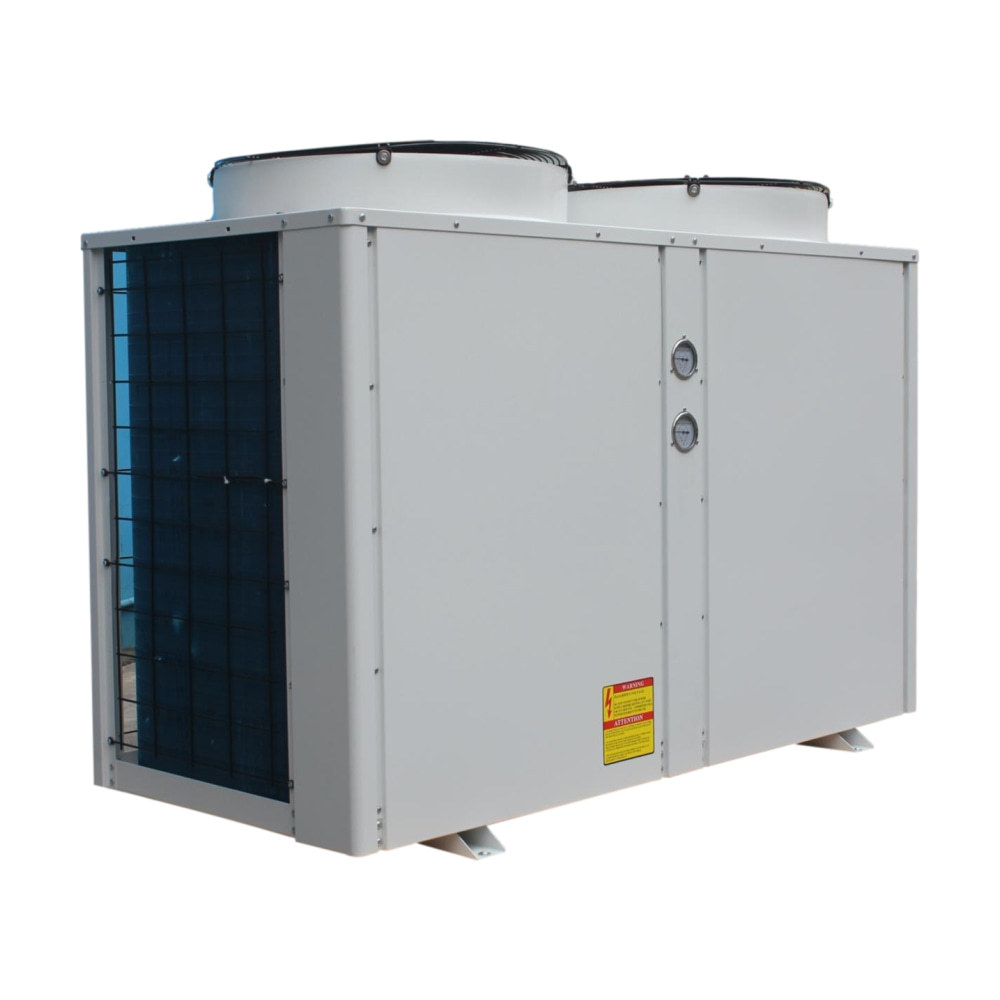
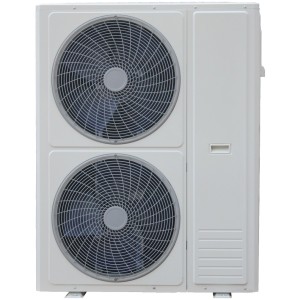
The Suoher SHAW-34EVIM monobloc heat pump, shown above, can be factory-configured with a heat-recovery circuit for simultaneous cooling and hot water production.
In a 200-room resort in a Mediterranean climate, the cooling load during peak season can exceed 300 kW. Diverting even 40% of condenser heat to the hot water system yields 120 kW of free water heating — enough to cover the hotel's entire midday and evening hot water demand without the heat pump compressors running at all. The combined COP during simultaneous heating and cooling operation can exceed 6.0, meaning every 1 kW of electricity produces 6 kW of useful thermal output.
Suoher integrates heat-recovery circuits into its commercial heat pump line at the factory level. The SHAW-34EVIM can be configured with a desuperheater option that delivers 60°C+ domestic hot water while the main circuit provides space heating or cooling, making it ideal for hotels that need both services simultaneously.
Case Study: Resort Hot Water with Heat Pumps
A 180-room resort in southern Spain replaced its aging diesel boiler plant (350 kW) with a cascade of three Suoher SHAW-90CV heat pumps (270 kW total) plus an 8,000 L buffer tank. The property also added a heat-recovery circuit on its existing chiller to pre-heat the tank during summer cooling operation.
The project was commissioned in March 2025 and monitored for 12 months. The results below are drawn from the resort's energy management system and verified by the engineering contractor.
Energy Cost Before/After
| Metric | Diesel Boilers (Before) | Heat Pump Cascade (After) |
|---|---|---|
| Annual energy cost | €52,000 | €21,500 |
| Annual maintenance cost | €6,500 | €2,200 |
| CO₂ emissions | 95 t/year | 14 t/year |
| Hot water reliability | 2–3 outages/year | 0 outages/year |
| Guest comfort complaints | 12 per year (cold water) | 0 per year |
Payback
The total system cost — equipment, installation, buffer tank, piping modifications, and commissioning — came to €145,000. The annual savings in energy and maintenance total €35,300, yielding a simple payback of 4.1 years.
The heat pumps also qualified for the Spanish regional heat-pump subsidy (Plan MOVES 3), which returned €18,000 to the property — reducing the effective payback to 3.6 years. After year 5, the system generates over €35,000 in net savings every year for the remaining 10–15 years of equipment life. According to the European Heat Pump Association (EHPA), hospitality-sector heat pump retrofits across Southern Europe are averaging 3.5–5 year paybacks in 2025–2026, driven by the gap between fossil fuel tariffs and heat pump COP economics.
Specifying for Your Project
Once the demand calculation and system architecture are defined, three specification decisions determine whether the installed system performs as designed — or disappoints for the next 15 years.
COP at Design Temperature
Published COP values are measured at standard rating conditions (A7/W35 for space heating, A20/W15 for pool heating). Hotels rarely operate at these conditions. For a year-round hotel in a European climate, the design heating COP should be checked at A−5/W50 or A0/W50 — the conditions that actually occur during winter peaks when hot water demand is highest.
The SHAW-90CV maintains a COP of 2.8–3.2 at A−5/W50, which is strong for a commercial unit at low ambient. Always ask the supplier for a COP curve across the operating range, not just the headline number. A unit that claims COP 4.5 at A7 but drops below 2.0 at A−5 will underperform in winter when you need it most.
Noise Compliance
Hotel installations often sit on rooftops or in plant rooms adjacent to guest rooms. Noise compliance is a regulatory and guest-experience issue:
- Night-time limit: 45 dB(A) at the nearest room facade (many EU municipalities)
- Daytime limit: 55 dB(A) at the property boundary
- Rooftop installations: add acoustic enclosures or position units at least 10 m from the nearest room wall
Suoher's commercial units include DC fan motors with stepless speed control, which automatically reduce fan speed at night to cut noise by 6–8 dB. The SHAW-34EVIM operates at 58 dB(A) at full load, dropping to approximately 50 dB(A) in night mode — well within typical hotel noise limits when properly positioned.
Backup Redundancy
Every commercial hot water system needs a backup path so that a single component failure does not leave 200 rooms without hot water:
- N+1 heat pump redundancy: install one more unit than the peak-load calculation requires. If the calculation says two SHAW-90CV units, install three.
- Electric immersion heater in the buffer tank: sized at 15–20% of heat pump capacity, for emergency top-up during extreme cold or maintenance shutdown.
- Cross-connection to a standby boiler: some properties keep one gas boiler as a cold-weather backup during the transition period, especially in Northern European climates where winter ambient drops below −10°C.
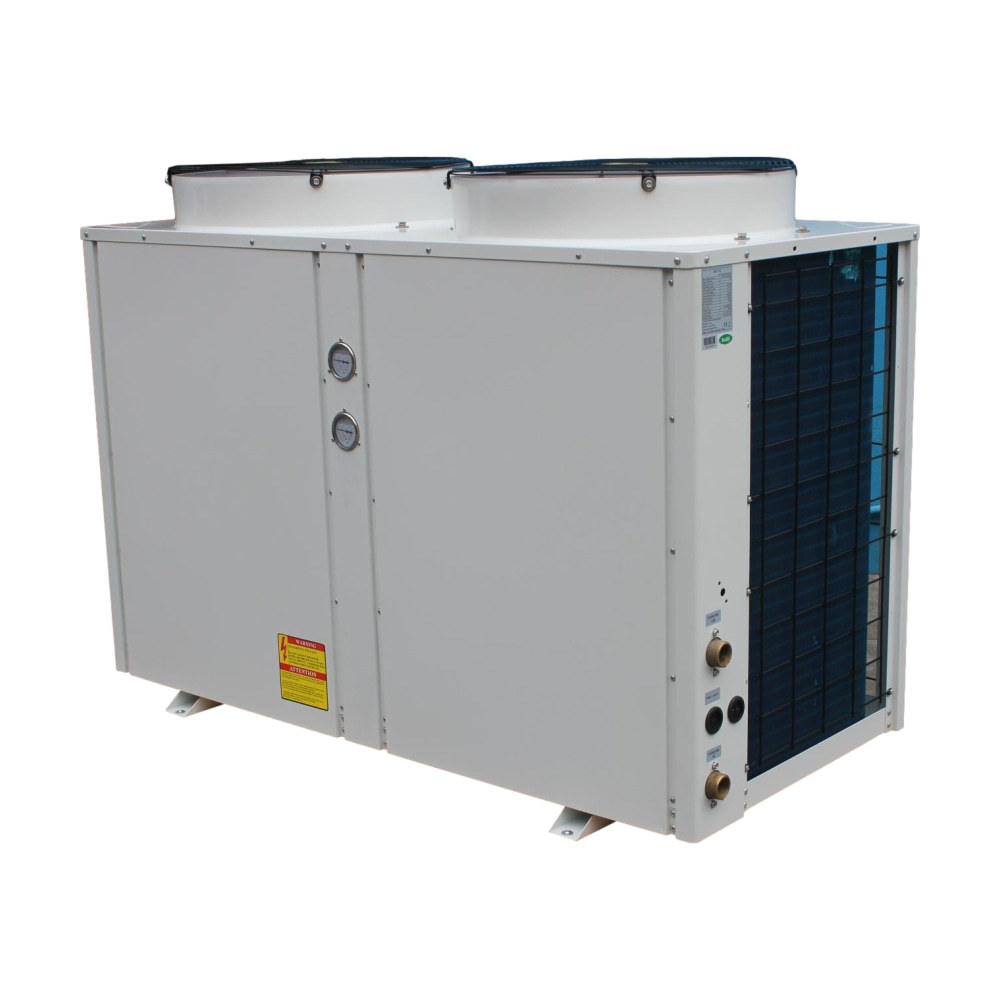
Suoher SHAW-34EVIM — 34 kW EVI Monobloc Heat Pump
- Rated power: 34 kW EVI low-ambient
- Power supply: 380V / 3-phase / 50Hz
- Air flow: 12,000 m³/h; fans: 250W × 2
- Low-ambient operation down to −20°C
EVI (Enhanced Vapor Injection) monobloc heat pump for heating, hot water, and summer cooling. Ideal for hotel plant rooms in cold-climate regions where winter ambient drops well below freezing. Cascade-ready with RS485 BMS integration.
View Product DetailsRequest a Custom Hotel Heat Pump System Design
Every hotel is different — climate zone, room count, occupancy patterns, existing plant infrastructure, and local regulations all shape the optimal heat pump configuration. Suoher's engineering team provides free system design support for hospitality projects worldwide, including demand calculation worksheets, cascade sizing recommendations, heat-recovery feasibility assessments, and quotation packages with certified performance data.
If you are planning a hotel or resort hot water system upgrade, contact Suoher to receive a project-specific design proposal within 48 hours. Our factory in Foshan, China ships commercial heat pump units to hospitality projects across Europe, the Middle East, and Southeast Asia — with CE, ErP, and Keymark certifications, OEM/ODM customization, and after-sales support partners in 40+ countries. Browse our commercial heat pump catalog or send an inquiry to start your project today.