How EVI Technology Works: Enhanced Vapor Injection for Cold Climate Heat Pumps
Conventional air-source heat pumps quietly lose roughly a third of their rated heating capacity once the outdoor temperature falls below -10°C, and they slip into inefficient, compressor-stressing operation long before that. Enhanced Vapor Injection (EVI) is the engineering answer that keeps modern cold-climate heat pumps delivering rated heat at -15°C, useful heat at -25°C, and stable discharge temperatures that protect compressor life. This guide walks you through the principle, the practical performance gains, and the questions worth asking any manufacturer before you write a purchase order.
1. Why conventional heat pumps struggle below -10°C
Standard single-stage vapor-compression heat pumps follow a thermodynamic curve that no marketing brochure can fix: as outdoor temperature drops, two things happen at the same time.
Capacity drop of 30-50%
The refrigerant absorbs less heat from a colder outside air stream, and the compressor must work harder to lift the reduced suction vapor to the required condensing temperature. A heat pump rated for 12 kW at A7/W35 (7°C outdoor, 35°C water) typically delivers only 7-9 kW at A-10/W35, and about 5-7 kW at A-15/W35. The end user feels the same setpoint, but the modulation kicks in and the backup heater quietly starts to take over.
High discharge temperature and oil degradation
Pushing a single-stage compressor to maintain condensing temperature in cold weather also pushes discharge temperatures above 110-120°C. POE oil thins, the bearing film weakens, valve plates fatigue, and the mechanical wear cycle accelerates. This is the structural reason standard residential heat pumps were not designed for sustained -15°C operation - and the reason early-generation "cold climate" models had such a poor field reputation.
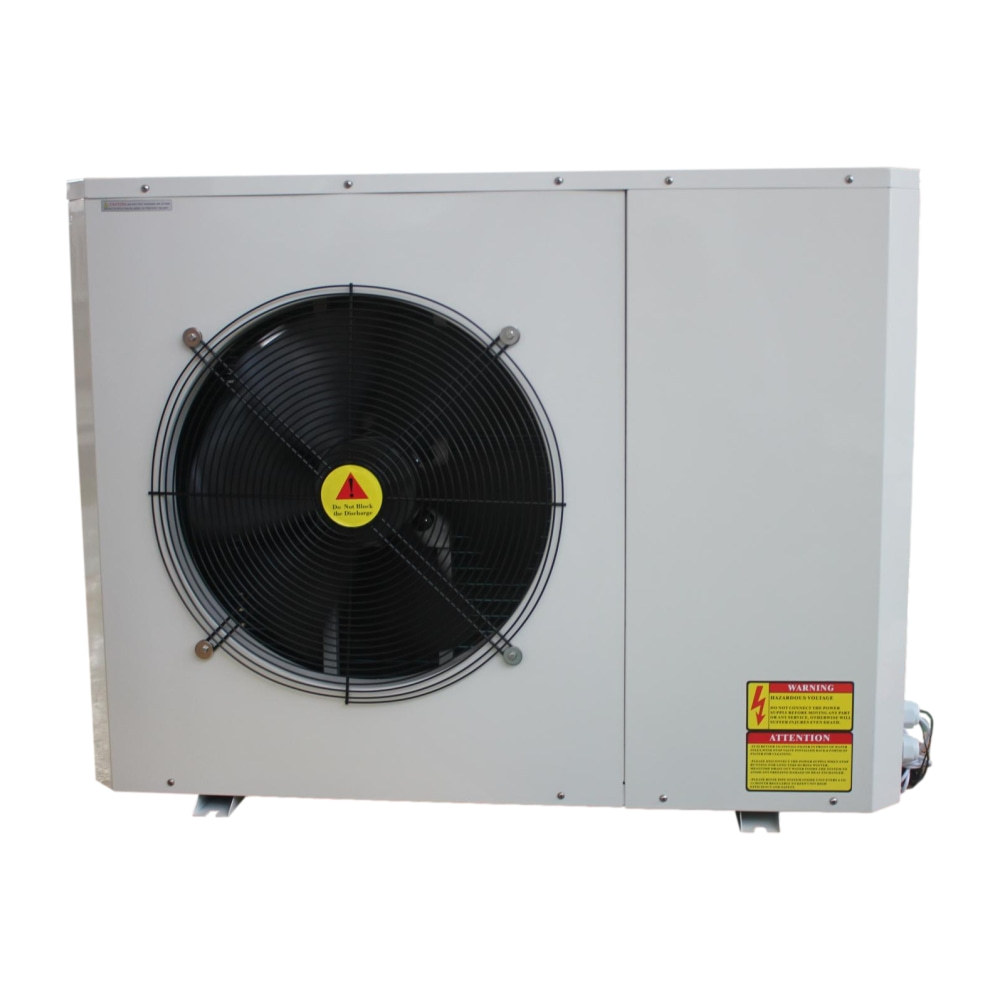
EVI monoblocs in this 12 kW class are the residential band where plain single-stage units lose too much capacity and switch on the backup element too often.
2. What is Enhanced Vapor Injection (EVI)?
Enhanced Vapor Injection is a quasi-two-stage compression technique. Instead of a single compression stroke from low-pressure vapor to high-pressure vapor, the refrigerant is partially condensed, then re-vaporized at an intermediate pressure and injected into an intermediate port of the scroll or screw compressor. The thermodynamic effect is that the compressor processes a smaller pressure ratio per stage, which translates directly into better efficiency, lower discharge temperature and more heating capacity at low ambient.
Quasi-two-stage compression explained
A conventional scroll compressor takes refrigerant from suction pressure to discharge pressure in one motion. An EVI-equipped compressor takes the refrigerant part of the way, then admits a second stream of cooler vapor at an intermediate pressure. The result is two smaller compression tasks instead of one large one - this is why EVI is often called “quasi two-stage” even though only one compressor is used.
Flash tank and economizer circuit
The hardware that creates the intermediate-pressure vapor is typically a flash tank or economizer. Condensed liquid leaves the condenser, passes through a throttle, partially flashes to vapor at the intermediate pressure, and the vapor is separated and routed to the compressor's mid-port. The remaining saturated liquid continues through the main expansion valve to the evaporator. Both the flash tank and the economizer designs are widely used; the choice comes down to packaging and charge optimization.
Mid-port vapor injection
The injection port is machined into the scroll set. Some manufacturers use the existing intermediate suction port designed for capacity modulation; others add a dedicated port specifically for the EVI circuit. Either way, the discipline of controlling the injected vapor mass is the differentiator between a properly tuned EVI system and one that merely has the hardware bolted on.
3. Three real benefits of vapor injection
Heating capacity uplift of 20-50% at low ambient
The headline number. Where a standard 12 kW A7/W35 unit delivers about 7 kW at A-10/W35, an EVI-equipped 12 kW unit delivers 9-11 kW at the same condition. That is the difference between a heat pump that can heat a typical 150 m² home at -10°C and one that has to call on the backup element every hour.
Discharge temperature drops 25-35°C
Splitting the pressure ratio halves the theoretical discharge temperature (the polytropic relation is not linear, but the direction is fixed). Lower discharge temperature means thinner oil stays thick enough, valve plates last longer, and the compressor can sustain heating output in extended cold snaps without triggering thermal cut-outs. For a manufacturer building a heat pump that will be used in Nordic, Alpine, or Northeastern US climates, this is the metric that determines product life.
Deeper subcooling and higher heating water temperatures
With the EVI circuit, more liquid leaves the condenser subcooled, and the system can deliver water temperatures of 55-60°C reliably even at low outdoor temperature. That matters for retrofit projects with existing radiator circuits and for domestic hot-water priority in winter, both of which call for higher flow temperatures than new-build underfloor systems.
4. EVI in practice: performance at -25°C
Performance data is where most marketing claims collapse. Two facts to anchor on:
COP retention vs standard units
In Suoher factory enthalpy-lab tests on a 12 kW EVI monobloc, COP at A-15/W35 stays in the 2.2-2.4 band, roughly 30-40% higher than an equivalent non-EVI unit that typically lands near 1.7 at the same condition. At A-20/W35, the EVI unit still produces around 60% of its rated A7/W35 capacity with a COP above 1.8, while a standard unit has essentially dropped out of the energy-efficient range.
Head-to-head comparison numbers
| Test point | Standard 12 kW ASHP | EVI 12 kW ASHP |
|---|---|---|
| A7/W35 capacity | 12.0 kW | 12.0 kW |
| COP at A7/W35 | 4.0-4.4 | 4.3-4.6 |
| Capacity at A-10/W35 | ~7.0 kW | ~9.5 kW |
| COP at A-10/W35 | ~2.3 | ~3.0 |
| Capacity at A-15/W35 | ~5.5 kW | ~8.5 kW |
| COP at A-15/W35 | ~1.7 | ~2.3 |
| Max useful water temperature | 50-55°C | 58-60°C |
These are not universal numbers - exact figures depend on the compressor vendor (Copeland, Highly, Panasonic are common in the segment), refrigerant (R32, R290, R454C), and the size of the EVI injection circuit - but the direction holds across all properly designed EVI units. If a manufacturer quotes higher numbers without showing you the test report, ask to see the underlying EN 14511 data sheet.
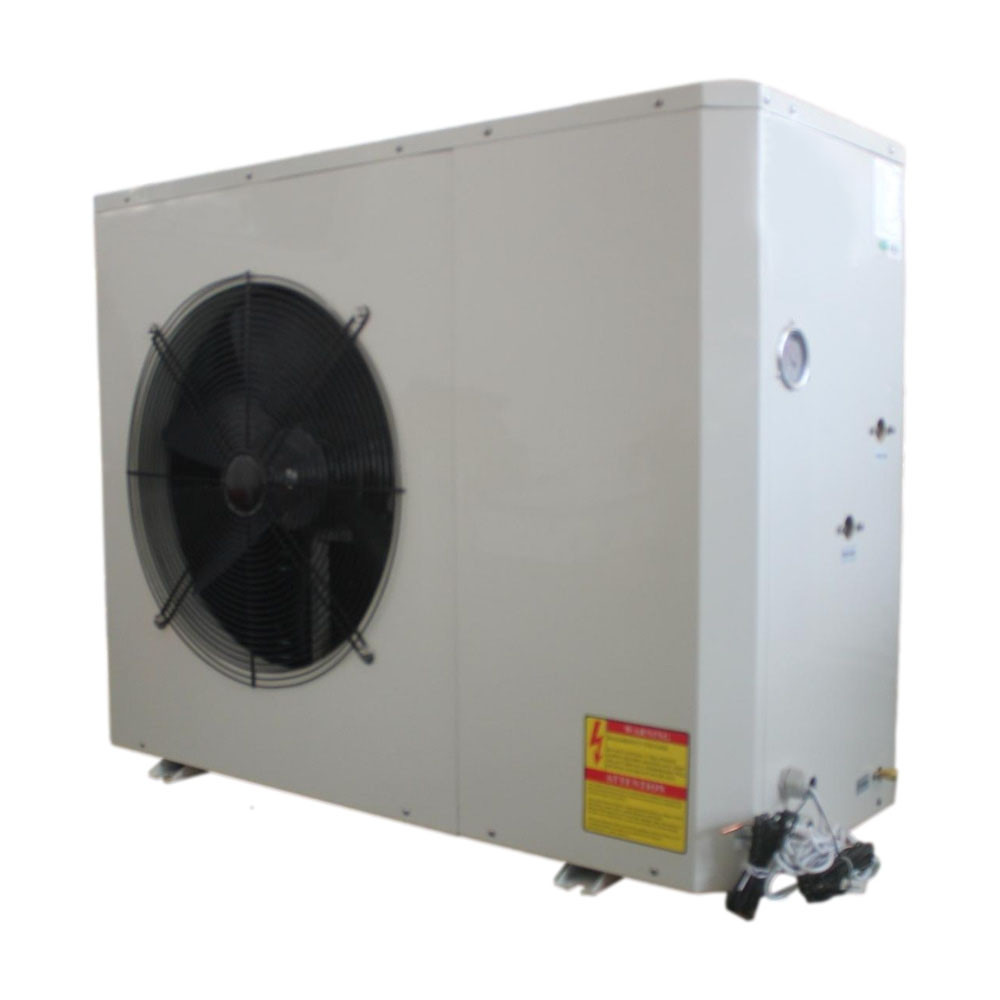
Single-phase 220V EVI monoblocs close the cold-climate gap for residential projects in regions where three-phase supply is not available.
5. EVI vs other cold-climate technologies
EVI is one of three mainstream ways to extend a heat pump's cold-climate envelope. Each has trade-offs.
Backup electric heating
The cheapest option at first glance and the most expensive to run. A typical 6 kW backup element lifts capacity at -15°C but pulls grid power at 100% efficiency: every kWh delivered by the element is a kWh purchased at retail. In Norway, Germany, or France where electricity is cheap relative to gas, this is acceptable. In the UK or Northeastern US where electricity is expensive, an oversized backup element quickly wipes out the heat pump's running-cost advantage.
Dual-stage (compound) compression
Two physically separate compressors staged by an outdoor thermostat or inverter controller. Delivers excellent cold-climate performance and is the workhorse of large commercial heat pumps. The downsides: higher cost, larger footprint, more service points, and the refrigerant plumbing must be factory-sized for the full load - meaning a single stage running alone is rarely as efficient as a single EVI unit at the same capacity.
EVI (quasi two-stage, single compressor)
Hits the middle ground: cost only slightly higher than a standard unit, capacity and efficiency uplift at low ambient comparable to a smaller compound system, and a single compressor service point. For residential and small-commercial projects up to about 40 kW, EVI is the dominant architecture on the market today, including competitor offerings such as the Mitsubishi Zubadan (a Hyper-Heat variant) and many Chinese OEM platforms.
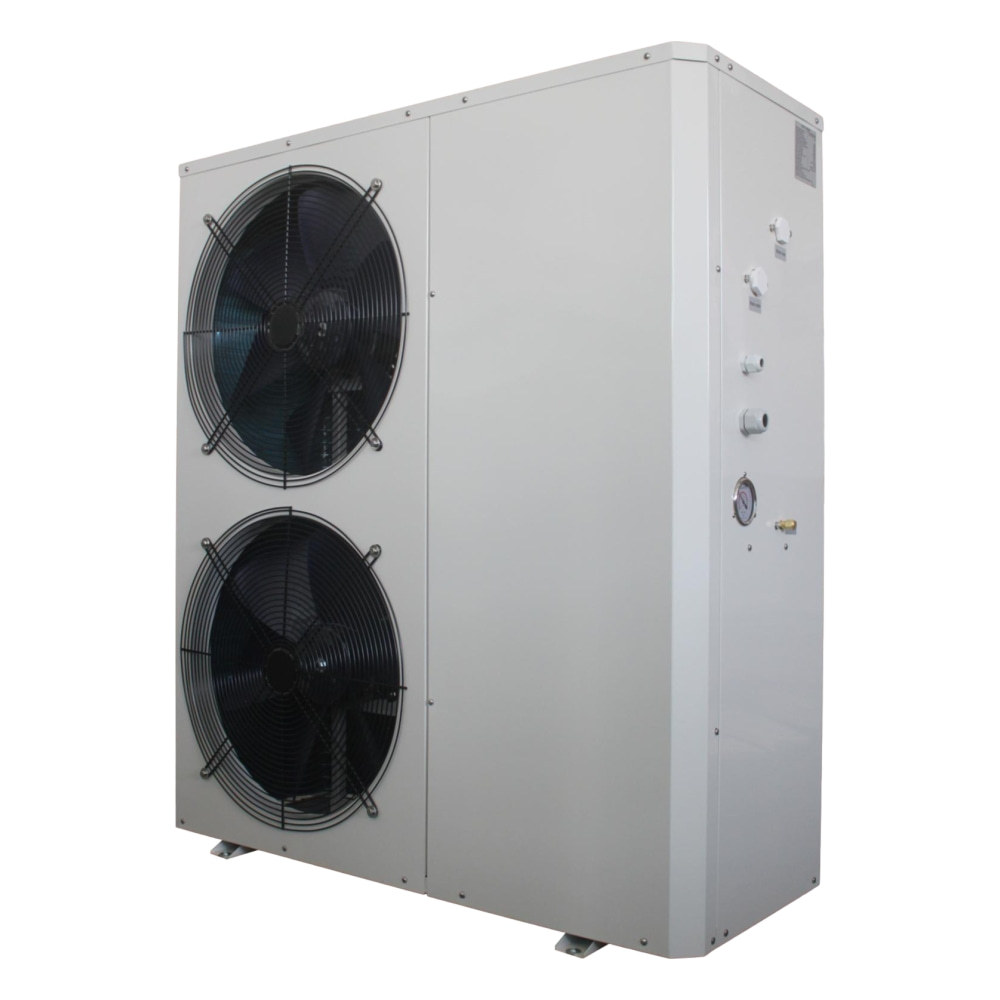
Low-ambient-temperature 12 kW EVI monobloc. Designed for sustained heating down to -25°C, with R32 or R290 charge options and factory enthalpy-lab testing on every unit.
6. How to verify EVI claims from manufacturers
Cold-climate heat pumps are an “easy claim, hard verify” category. Three things to ask before committing to any supplier.
Ask for the EN 14511 / EN 14825 test report
EN 14511 is the European standard for heating/cooling capacity and COP under controlled inlet conditions. A reputable manufacturer can hand you an EN 14511 report on the exact model number you are buying, with data points at A-7, A-10, A-15 and (for cold-climate rated units) A-20 or A-25. EN 14825 then turns those points into the seasonal SCOP you see on the energy label. If you only get a single -7°C COP and an “operates to -25°C” marketing line, treat it as a red flag.
Ask for -20°C capacity data, not just a -25°C claim
The single most useful question in cold-climate procurement is: “what is the heating capacity at A-20/W55?” A unit that delivers 60% of its A7 rating at this condition is genuinely usable. A unit that “starts” at -25°C but delivers 35% of its rating is essentially a low-output heater with a heat-pump badge. Make the supplier put the number in writing.
- Compressor make and model - confirmed and visible on the data plate; not just “high-performance scroll”.
- EVI port type and controller - flash tank or economizer, injection timing controlled by the manufacturer's own logic, not an aftermarket add-on.
- Factory test certificate - per-unit enthalpy-lab test results signed by a senior QC engineer on the production line.
- Refrigerant type and charge size - in writing. EU buyers should also confirm the unit is fully compatible with the 2027 F-Gas rules.
Larger projects step up to 16 kW EVI models without giving up the -25°C envelope or the single-phase 220V supply option.
7. Cold-climate field experience from our factory
Suoher has been building EVI monoblocs at its Foshan facility since 2017, with current production running roughly 35% to OEM/ODM brands for European and Central Asian distributors. Three lessons from the field are worth knowing before you write the purchase order:
First, refrigerant choice is now baked into EVI design. The 2027 EU F-Gas ban on R32 monoblocs drives most importers toward R290 EVI designs, but R290's A3 flammability class imposes smaller charge limits, which pulls capacity down by 10-15% versus an R32 unit of the same scroll size. Sizing a cold-climate system therefore needs a 15% capacity buffer if you are ordering R290 - something not all catalogs make obvious.
Second, the outdoor unit must be designed for the climate in writing. A heat pump rated for -25°C but installed without a base-pan heater will see ice build-up at the condensate drain that can warp the chassis inside two winters. Reputable EVI systems ship with integrated base-pan heaters, low-noise fans tested down to -25°C, and demand-defrost logic that suits high-humidity coastal regions.
Third, controller behavior decides customer satisfaction more than any spec on the box. Smart defrost algorithms that extend defrost intervals to 90-120 minutes (instead of fixed 30- or 45-minute cycles) can lift seasonal efficiency by 5-8% in real-world use. Ask the supplier which defrost strategy the unit uses and whether it is adjustable in the field.
Single-phase 220V EVI monobloc sized for residential homes where three-phase supply is unavailable. Designed and tested by our R&D team for sustained low-ambient operation.
Spec EVI Heat Pumps With Confidence: Request the Cold-Climate Test Bundle
Cold-climate heating is no longer the experimental edge of the heat pump market - it is the mainstream buyer requirement across Northern Europe, the Nordics, much of North America and the cold interior of China. The technology is mature, the supply base has broadened, and the engineering checks are well defined. What separates a reliable order from a regret is the test documentation behind the model and the engineering support around the controller.
If you are specifying an EVI monobloc for a 2026 project - whether you are an importer qualifying a new line, a project engineer sizing a 30-unit residential development, or a distributor planning your 2027 stock - Suoher can share model-specific EN 14511 / EN 14825 reports, COP retention curves at -10/-15/-20°C, and OEM/ODM configuration options tailored to your market. Tell us the climate band, the refrigerant target, and the certifications you need; we will return a data pack you can defend in front of any installer or inspector.
Browse the 12 kW EVI monobloc or 11 kW single-phase EVI monobloc product pages, or contact the Suoher export team to start a sample-order evaluation for your 2026/2027 cold-climate lineup.