How to Choose a Heat Pump OEM/ODM Manufacturer in China: The Complete Checklist
Why OEM/ODM Sourcing from China Works for Heat Pumps
Importers, distributors, and private-label brand owners have been buying heat pumps from Chinese factories for more than two decades, and the volume tells the story. Roughly 35% of the world's heat pump manufacturing capacity sits in China today, and Chinese exports of heat pumps rose above USD 1.5 billion in 2024 according to customs and IHS Markit trade data. For a European or North American buyer, that footprint translates into three concrete advantages: a mature supplier base, a deep component ecosystem, and substantially lower factory-gate prices than equivalent EU or North American production. Foshan-based lines such as Suoher's are typical of the vertically integrated factories that drive this volume, with suction-line assembly, brazing, vacuum charging, enthalpy testing, and packaging on a single site.
~35% of global capacity
By the IEA's 2024 tracking, China hosts the largest concentration of heat pump manufacturers worldwide. The wider Pearl River Delta alone accounts for a sizeable share of that volume, with compressor sourcing, copper brazing, electronics assembly, and final testing all reachable within a 100 km radius. The Chinese heat pump cluster also feeds a domestic market that absorbed 12+ million split and unitary heat pump units in 2024, so the production lines run year-round and the workforce stays in practice. That continuous throughput is hard to replicate in markets where the heating season is short.
Cost advantage vs EU production
Factory-gate price for an equivalent 10 kW monobloc air source heat pump typically lands at EUR 700–900 ex-works from a Chinese line, versus EUR 1,800–2,400 from a Western European or US producer (a representative spread drawn from 2024 procurement surveys and trade press reporting). The gap narrows after freight, duty, warranty reserve, and inventory carrying cost — typically 40–55% of those savings survive — but even that residual gap is what funds distributor marketing budgets, installer margin, and rebate programmes in destination markets. For private-label buyers, that surplus is what the entire brand economics rest on.
The 8-Point Factory Evaluation Framework
Picking a Chinese OEM/ODM partner is risky if you only compare price lists. The eight-point framework below is what experienced private-label buyers use to qualify and de-risk a factory before committing working capital. Run every candidate through the same eight filters and the decision usually becomes much clearer.
1. Certification stack (CE / ErP / Keymark / MCS / AHRI / UL)
Confirm the certifications actually cover the model you plan to ship — not just the brand. CE marking and ErP Ecodesign are mandatory in the EU; Keymark is the voluntary pan-European mark many installers prefer; MCS (UK) and BAFA (Germany) are tied to subsidy eligibility; AHRI is what earns ENERGY STAR recognition in North America; UL or ETL is the minimum for residential sales in the US. Ask for the certificate PDF and look up the certificate number in the issuing body's database; a declaration that lists "all models in the SHAW series" without specifying individual SKUs is a flag worth investigating. A factory claiming CE without listing the model on the declaration is a deal-breaker for European importers.
2. Refrigerant strategy (R32 and R290 readiness)
From 1 January 2027, the EU's revised F-Gas Regulation freezes virgin HFC refrigerants with GWP above 150 in many heat pump categories — that pushes buyers toward R32 (GWP 675) for short-term continuity and R290 (propane, GWP 3) as the long-term solution. A qualified OEM should already run a parallel R32 and R290 production line, with R290 charging done in a separately ventilated, ATEX-rated bay. Ask to see the R290 charging bay photos, the leak-test station logbook, and the flammability testing record. R290 equipment also reaches into the UK's Future Heat Standard consultations, where R290 is the default reference technology for residential new build.
3. OEM/ODM maturity (logo, controller firmware, app)
True ODM maturity shows up in three places: silkscreen and labelling (your brand colour-matched, your model number, your packaging), controller firmware (boot logo, default setpoints, language strings, error codes), and the Wi-Fi app (white-labelled icon, account server in your region, custom push-notification templates). Mature factories can support all three with no engineering change order. Suoher's in-house UX team, for example, has shipped white-label firmware and iOS/Android app builds for distributors in Germany, Poland, Australia, and South Africa — a level of localisation that separates a true ODM partner from a simple reseller.
4. Product line breadth
A factory with one or two SKUs forces you into its product roadmap. A factory running residential split, monobloc, EVI, water heater, and commercial units on the same platform lets you grow your catalogue without re-qualifying a new supplier. Check the SKU count and ask how many new platforms they have launched in the last three years. Breadth also cushions you against component shortages: a factory using the same compressor family across 6 kW, 9 kW, 12 kW, and 16 kW units can switch SKUs when a single compressor supply line is constrained.
5. Testing lab capability
Every factory says it tests. The question is whether it tests in-house under a calibrated EN 14511 / EN 15450 chamber, or whether it ships untested units and relies on the customer's acceptance test. A qualified OEM runs an in-house enthalpy lab with multiple climatic chambers (−25 to +45 °C air-side, 25–65 °C water-side) and can produce serial-numbered test reports for every unit on request. Watch out for factories that show lab photos on the website but cannot produce a specific test report tied to a serial number you supply. Suoher runs a ten-station enthalpy lab with parallel water and air conditioning, ISO 17025-aligned calibration, and signed-off thermal performance reports for every production batch — a standard worth verifying during any factory audit.
6. Production scale and lead time
Look past the annual capacity number and look at peak-quarter output. A 100,000-unit/year factory that runs five days a week year-round is a very different risk profile from one that bursts to 30,000 units in Q4 then idles in Q1. Probe current backlog, peak-month shipment count, and signed component supply agreements. Standard 12 kW monobloc lead time of 25–35 days after PO is normal in steady state; 60+ days usually means capacity is oversold or component supply is single-sourced. Also confirm whether the factory allocates dedicated production lines for OEM accounts or pools OEM volume into a general production queue.
7. Export track record
Ask for the last twelve commercial invoices for the destination market you care about. An OEM with steady shipments to your target market already knows the shipping route, the local paperwork, the local certification body, and which container line keeps delivery on schedule. First-time exporters to a market tend to underestimate customs delays and after-sales call volume. Suoher, for example, ships to 40+ countries and can provide reference distributors in most EU member states, the UK, Australia, and South Africa on request under NDA.
8. After-sales and spare parts
Heat pumps are 15–20 year assets. The OEM's commitment to spare parts availability across the unit's lifetime is non-negotiable. Ask for a written spare-parts availability commitment (typically 5–7 years from end of production), the spare-parts warehouse location relative to your market, and the warranty claim turnaround SLA. Anything less than 48 hours for parts dispatch is tough to live with for installers covering large service territories. Also confirm whether the factory has a regional service partner or wholly relies on the importer for warranty fulfilment.
Red Flags and How to Verify Them
Even with a checklist, a few patterns keep showing up in failed OEM relationships. Here are the two most common, and how to verify each one before you commit money.
Internal-test-data-only claims
Some factories quote a COP, noise level, or heating capacity that is drawn entirely from internal testing — possibly in a chamber that is not calibrated to EN 14511 standard reference conditions. How to verify: ask for a third-party test report from TÜV, Intertek, SGS, DEKRA, or another accredited lab covering the same model. A real third-party report will carry the test body's logo, the standard reference (EN 14511, EN 14825, EN 12102), and a fixed report number you can look up in that lab's online database.
Certificate vs model coverage mismatch
It is surprisingly common for a factory to claim "CE certified" while the actual CE declaration covers only one model variant in a family. How to verify: open the EU Declaration of Conformity (DoC) PDF and read every model number on the list. Cross-check that every SKU you plan to buy is explicitly named. If the model is not on the DoC, the importer (you) carries the legal liability in the destination market — an exposure that can turn into a customs seizure, a retailer de-listing, or a national-market corrective-action notice.
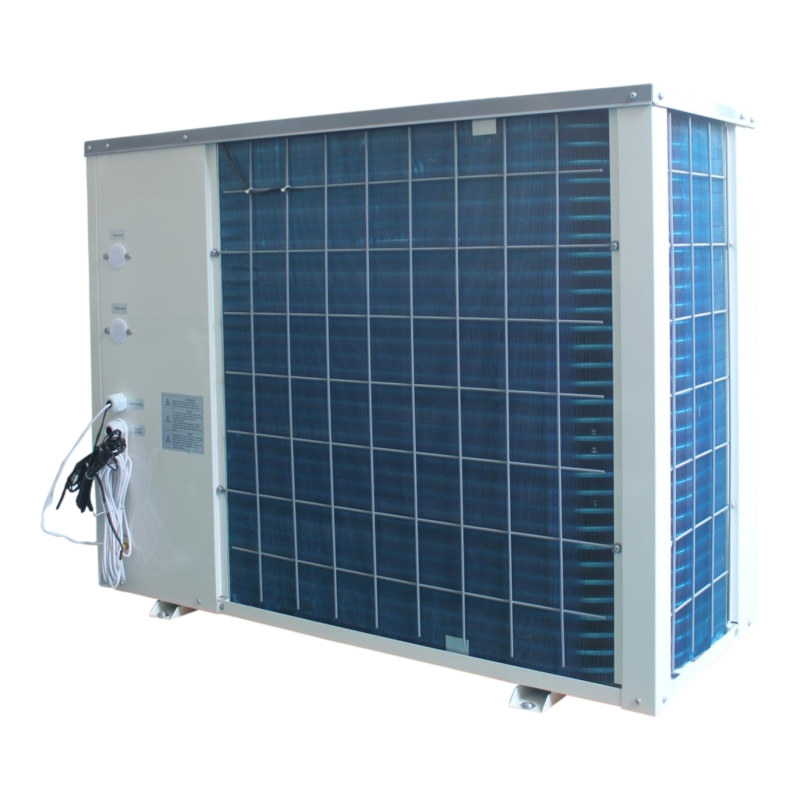
A 9 kW DC inverter unit on the pre-shipment test bench. A factory that runs serial-numbered test data for every production batch is far easier to defend in a warranty conversation than one that quotes generic catalog figures.
Sample Order Process: From Inquiry to First PO
A well-run OEM turns a sample inquiry into a production order in 30–45 days. Here is the typical sequence: technical fitment (1–2 weeks of email back-and-forth on specs, refrigerant, power supply, controls, hydraulic connections), NDA and pricing (1 week), deposit and sample build (2–4 weeks on a running production line), sample evaluation (you test for 1–2 weeks), tooling or artwork (3–4 weeks if you are rebranding), and PO with deposit (1–2 weeks negotiation). Factories that compress this into under four weeks are usually skipping something — typically the sample evaluation or the conformity paperwork. After first PO, monthly volume deliveries settle into a regular rhythm once tooling and supply chain are validated.
What to test in the sample phase
Send a clear acceptance protocol before the sample arrives. Cover heating capacity at A-7/W35 and A-15/W35, COP at A7/W35, sound power per EN 12102, defrost cycle behaviour at −10 °C and 90% RH, and any control or Wi-Fi features that the datasheet claims. Demand signed serial-numbered test data for the actual sample you receive, not a generic datasheet pulled from the factory website. If the project engineer pushes back on a written acceptance protocol, treat that as a red flag — transparency should not be a separate line item.
NDA, IP, and Exclusivity: Protecting Both Sides
An OEM relationship only works if both sides can plan around clear IP terms. Three pieces belong in every NDA: (1) non-disclosure of your brand assets, drawings, and controller firmware requirements; (2) non-compete clause — the factory agrees not to sell a competing unit under the same model number or artwork into your territory; and (3) tooling ownership — whoever pays for tooling owns it, period. Push for a Chinese-English bilingual NDA executed under your home jurisdiction (Germany, UK, US, Australia) rather than PRC law; it makes any future dispute faster to enforce.
Exclusivity is a separate question. A factory will usually grant territory exclusivity for one year with a 5,000–10,000 unit minimum purchase commitment, renewable on volume. Avoid permanent exclusivity — it locks you in and locks the factory out of upside in that market, which tends to weaken engagement over time rather than strengthen it.
Case Study: What a Good OEM Partnership Looks Like
A Stuttgart-based HVAC distributor we have worked with for seven years started exactly where most importers do: sample, qualify, first 200-unit PO, growing to 4,500 units/year by their third year. Their original requirement was a 9 kW DC inverter monobloc rebranded under their own logo, with a controller UI in German and a Wi-Fi app localised to DIN-spec heating curves. The OEM delivered three sample iterations in 60 days, signed an NDA covering the controller source code, and shipped the first 200 units with serial-numbered test data for each one. By year four the distributor had added a 16 kW EVI cold-climate model, a 6 kW split unit, and a 200-litre hot water tank — all built on the same OEM platform with minor cosmetic variations.
Two factors made the relationship durable. First, the distributor maintained a single point of contact at the factory — no handoffs, no re-explaining. Second, the factory assigned one project engineer who owned the OEM account end-to-end, including the controller team, the lab signoff, and the warranty pipeline. That single point of accountability is harder to find than it sounds, and it is what compressed year-three's new-model introduction from the typical 12 weeks down to 5.
Checklist Download + How Suoher Measures Up Against the Eight Points
The eight-point framework above is what you should demand from any candidate OEM. Here is how Suoher measures against each one — written directly by the engineering team, including the honest gaps so you can compare like-for-like. The full self-assessment, sample first-article inspection reports, and reference distributor contacts live in the OEM capability pack; the table below is the executive summary.
| # | Criterion | What to ask the factory | Suoher self-check |
|---|---|---|---|
| 1 | Certifications | CE + ErP + Keymark + MCS / AHRI / UL on file for every model? | CE + ErP on SHAW series; Keymark in progress for SHAW-12EVIM; MCS application initiated. AHRI listing on commercial SHAW-90CV. Third-party reports from TUV/SGS in the dossier. |
| 2 | Refrigerant strategy | Separate R32 and R290 lines with ATEX-rated charging bay? | R32 production since 2021; R290 ATEX line commissioned in 2024 with dedicated charging and leak-test bay. R290 training documented for every operator. |
| 3 | OEM/ODM maturity | Logo, controller firmware, app re-skinning in-house? | In-house UX team; white-label firmware and iOS/Android app shipped to distributors in DE / PL / AU / ZA. Custom controller UI and language pack available on request. |
| 4 | Product line breadth | Residential + commercial on a shared platform? | Residential split, monobloc, EVI, DHW plus commercial 30–90 kW SHAW series on a shared compressor platform. New 16 kW EVI split launched 2025. |
| 5 | Testing lab capability | In-house calibrated chamber plus serial-numbered test data? | Ten-station enthalpy lab with parallel water and air conditioning; per-unit test report issued by serial number and counter-signed by the test engineer. |
| 6 | Production scale | Peak-quarter output and signed component supply? | Annual capacity ~120,000 units; 12-month compressor supply agreement with GMCC; peak-month shipment ~14,000 units. Two dedicated OEM assembly lines reserved. |
| 7 | Export track record | Recent invoices in your destination market? | Active shipments to 40+ countries; referenceable distributor list available on request under NDA. Three reference EU distributors available in DE/PL/NL. |
| 8 | After-sales | Spare-parts commitment and warranty SLA? | 3-year compressor warranty, 2-year parts; 7-year spare-parts availability from end of production; 48-hour spare-parts dispatch from Foshan warehouse plus regional buffer stock. |
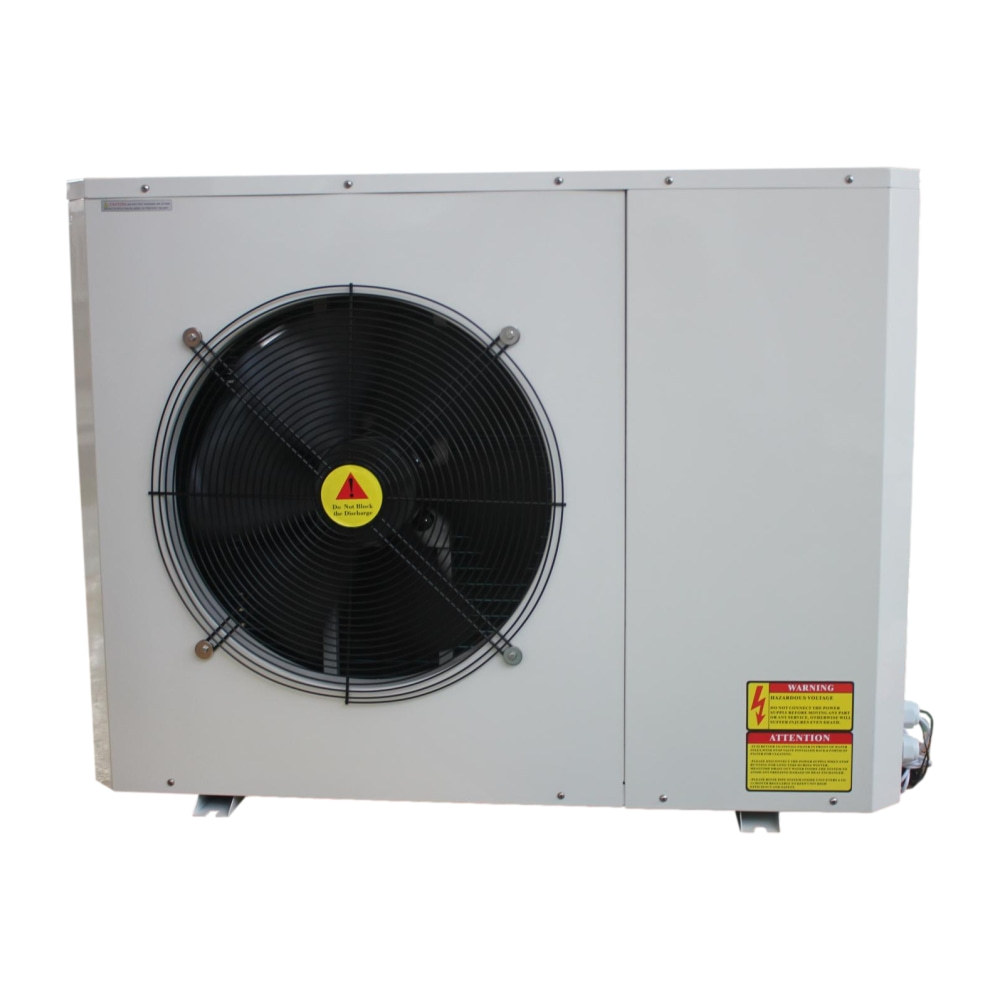
Cold-Climate 12 kW EVI Monobloc
Model: SHAW-12EVIM
- Heating capacity: 12 kW (380 V / 3-phase)
- Operating ambient: down to -25 °C (EVI)
- COP up to 4.3 at A7/W35
- Sound power: 58 dB(A) at 1 m
- White-label firmware and Wi-Fi app available for OEM partners
A flagship unit for cold-climate markets. Monobloc architecture means no on-site refrigerant work for installers — a strong differentiator for OEM partners selling into Nordic, Alpine, and Eastern European markets. R32 refrigerant with optional R290 development board. Read the EVI technology deep dive if you need the engineering detail.
View ProductIf you want a single document you can hand to your procurement team — the eight-point framework pre-filled with these Suoher answers, plus sample first-article reports and reference distributor contacts — request the OEM capability pack here. Suoher will return a signed PDF plus a 30-minute engineering call within two business days.
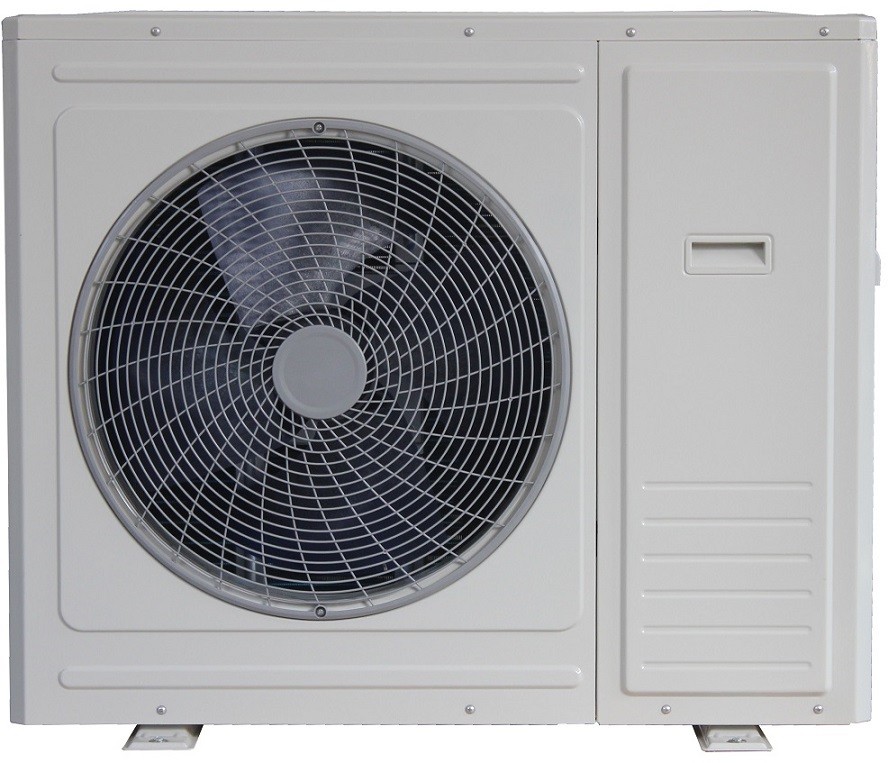
Economical DC Inverter Heat Pump (OEM Entry Point)
Model: SHAW-9DM1/K
- Heating capacity: 5.1–8.9 kW
- Heating power input: 1.98–3.39 kW
- COP: 1.5–4.49 (inverter-modulated)
- GMCC inverter compressor, R32 refrigerant
- Compact cabinet 1110×460×850 mm; 90 W DC fan
A flexible entry-level SKU for distributors launching a private-label heat pump range. Modulating capacity covers most apartment and small-house loads, while the GMCC compressor and proven control board keep field failure rates low. Frequently chosen as the second SKU after a higher-end EVI unit.
View ProductLock In a Reliable China OEM: Request Suoher's OEM Capability Pack and First-Article Sample
Choosing a Chinese OEM/ODM manufacturer is a 15–20 year decision disguised as a one-time purchase order. The factory you pick today is the factory your installer training programme, your spare-parts pipeline, and your brand reputation will ride on. Treat the selection like the strategic decision it is — run every candidate through the eight-point framework, verify the certifications in the issuing body's database, ask for serial-numbered test data on the actual sample, and demand a written spare-parts commitment.
If Suoher matches the shape of what you are sourcing, the fastest path forward is the OEM capability pack: a pre-filled eight-point self-assessment, sample first-article inspection (FAI) reports, a controller firmware demo, and a 30-minute engineering call with the project engineer who will own your account end-to-end. Request the OEM capability pack below and Suoher will return it within two business days, plus a sample price list on the SKUs you specify.
You are also welcome to book a factory audit in Foshan, browse the full DC inverter and commercial product line-up, or read more on heat-pump technology, OEM, and ODM topics in the Suoher blog library.