Inside a Heat Pump Factory: Production, Testing and Quality Control
Every heat pump that leaves a factory carries more than refrigerant and copper. It carries the quality decisions made at dozens of stations along the production line: how the coil is bent, how the compressor is mounted, whether the unit was run-in under load, and whether the final leak test caught a 0.5 g refrigerant loss that could become a warranty claim two years later. For importers, distributors, and OEM buyers, understanding what happens inside a heat pump factory is not a nice-to-have tour stop — it is due diligence.
In this article we walk through a modern heat-pump manufacturing operation, from raw materials to final dispatch, with a focus on the checks that separate a reliable long-life unit from a cheap box that will eat your margin in service calls. The process described here reflects the workflow Suoher uses at its Foshan facility for DC inverter heat pumps, EVI low-temperature units, commercial air-to-water systems, and swimming-pool heat pumps.
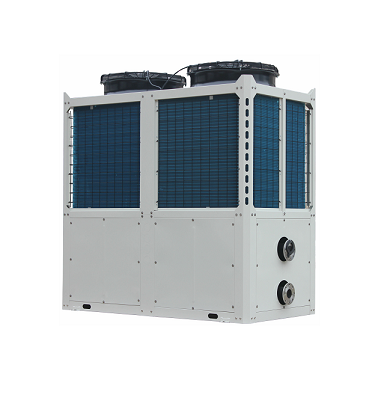
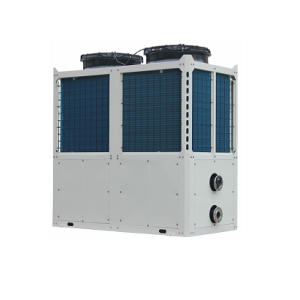
The Suoher SHAW-90CV 90 kW commercial air-to-water heat pump is an example of a unit that moves through coil winding, compressor mounting, refrigerant charging, enthalpy-lab testing, and final dispatch in a single production cycle.
Why Factory Transparency Matters to Buyers
Heat pumps are electromechanical systems that are expected to run for 10–15 years in outdoor conditions. A buyer who only checks the price sheet and the glossy brochure is gambling on the invisible 80% of the value chain: the factory floor. Factory transparency matters because it directly predicts four business outcomes:
- Consistency: documented assembly and test stations reduce batch-to-batch variation, so the sample you approved in March performs like the container you receive in October.
- Warranty exposure: units that skip run-in tests or leak detection have higher infant-mortality failure rates, which flow straight back to the importer or installer.
- Certification validity: a CE mark is only as good as the production line that repeats the tested sample. Auditors look for production control, not just paperwork.
- OEM credibility: if you are putting your own brand on the unit, your reputation depends on the factory's discipline more than your logo.
Suoher publishes production and testing data openly because the cost of hiding a weak process is always higher than the cost of fixing it. Buyers who visit — physically or virtually — should know what to look for at each station.
From Raw Materials to Assembly
A heat pump is fundamentally a refrigerant circuit moving energy between air, water, or ground and the building. The production process therefore revolves around building a tight, clean refrigeration loop and protecting it with reliable electrics and controls.
Coil Production
The condenser and evaporator coils start as copper tube and aluminum fin stock. The tube is bent into the designed circuit, hydroformed to remove burrs, and then laced with fins. The fin spacing, tube diameter, and circuit length are fixed by the thermal engineer; any deviation changes the COP by a measurable margin. After brazing, coils are pressure-tested with nitrogen to verify joint integrity before they ever meet the compressor. At Suoher, coil assemblies for inverter models are matched to the compressor map so that the refrigerant side and the air side are balanced across the operating range.
Compressor Mounting
The compressor is the heart of the unit and the most vibration-sensitive component. Mounting torque, rubber damper compression, and crankcase heater placement are all controlled by jigs. Inverter units receive DC inverter compressors from approved suppliers, while EVI low-temperature models receive enhanced-vapor-injection compressors with the secondary injection port oriented to the economizer circuit. A mismounted compressor does not fail immediately; it fails 18 months into service when the refrigerant line fatigues. That is why Suoher records torque values by unit serial number.
Refrigerant Charging and the R290 Explosion-Proof Line
Refrigerant charge is one of the most consequential steps. Too little charge lowers capacity and can freeze the evaporator; too much raises discharge pressure and reduces compressor life. Charge accuracy is typically held within ±10 g on small residential units and ±30 g on commercial systems. For R290 and other flammable refrigerants, the charging station is isolated in an explosion-proof room with sealed electrical fittings, gas detection, and ventilation interlocks — not just a bench in the corner. Suoher's R290 line follows IEC 60335-2-40 installation-category requirements and charges units in a controlled atmosphere before final sealing.
Featured Unit: SHAW-90CV 90 kW Commercial Air-to-Water Heat Pump
- Model: SHAW-90CV
- Power: 90 kW heating capacity
- Power supply: 380 V / 3-phase
- Control: Built-in Wi-Fi + RS485 for cascade control
- Use case: Hotels, hospitals, apartment blocks, commercial DHW
The SHAW-90CV is designed for modular cascade installation and controlled production from coil winding through final leak test. Its RS485 interface lets building-management systems stage up to 16 units for redundancy and partial-load efficiency.
View ProductTesting: The Non-Negotiable Stage
Assembly creates the hardware; testing proves that the hardware performs. A credible factory does not treat testing as a final rubber stamp. It is a continuous feedback loop that catches defects, calibrates production, and validates design changes.
Enthalpy Lab Performance Testing
The enthalpy laboratory is the closest thing a factory has to a truth machine. It measures heating capacity, COP, power input, airflow, and water-side pressure drop across controlled indoor and outdoor conditions. A typical test cycle runs the unit at rated conditions (e.g., A7/W35 for air-source units) and at least one extreme point (A2/W35 or A-7/W35) to confirm low-temperature performance. The lab compares measured capacity against the design target; if a unit is more than 3% off, production stops until the root cause is found. Suoher's in-house lab is calibrated against third-party certification labs so that in-house results predict official test-house results.
Run-In Tests
Also called burn-in or aging tests, run-in cycles operate the unit for several hours at full load and partial load. The goal is to expose infant-mortality defects: a weak solder joint, a sticking expansion valve, a noisy bearing, or a control board that resets under thermal load. Units that pass run-in are far less likely to fail in the first 90 days after installation, which is the most expensive failure window for any importer.
Electrical Safety and Hi-Pot Testing
Every unit receives dielectric strength (hi-pot), ground continuity, and insulation-resistance checks. These tests verify that live parts cannot reach the casing or the water circuit. For units sold in Europe, the test protocol aligns with the low-voltage directive and IEC 60335 safety standards. Failed units are stripped and rebuilt; they are not patched and shipped.
Leak Detection
Refrigerant leaks are a warranty and environmental liability. After evacuation, the system is charged with nitrogen or trace gas and checked with electronic leak detectors and, on many lines, helium mass spectrometry for high-sensitivity verification. Suoher applies 100% leak detection on flammable-refrigerant units and batch detection on R410A/R32 units, with sampling rates above AQL 1.0.
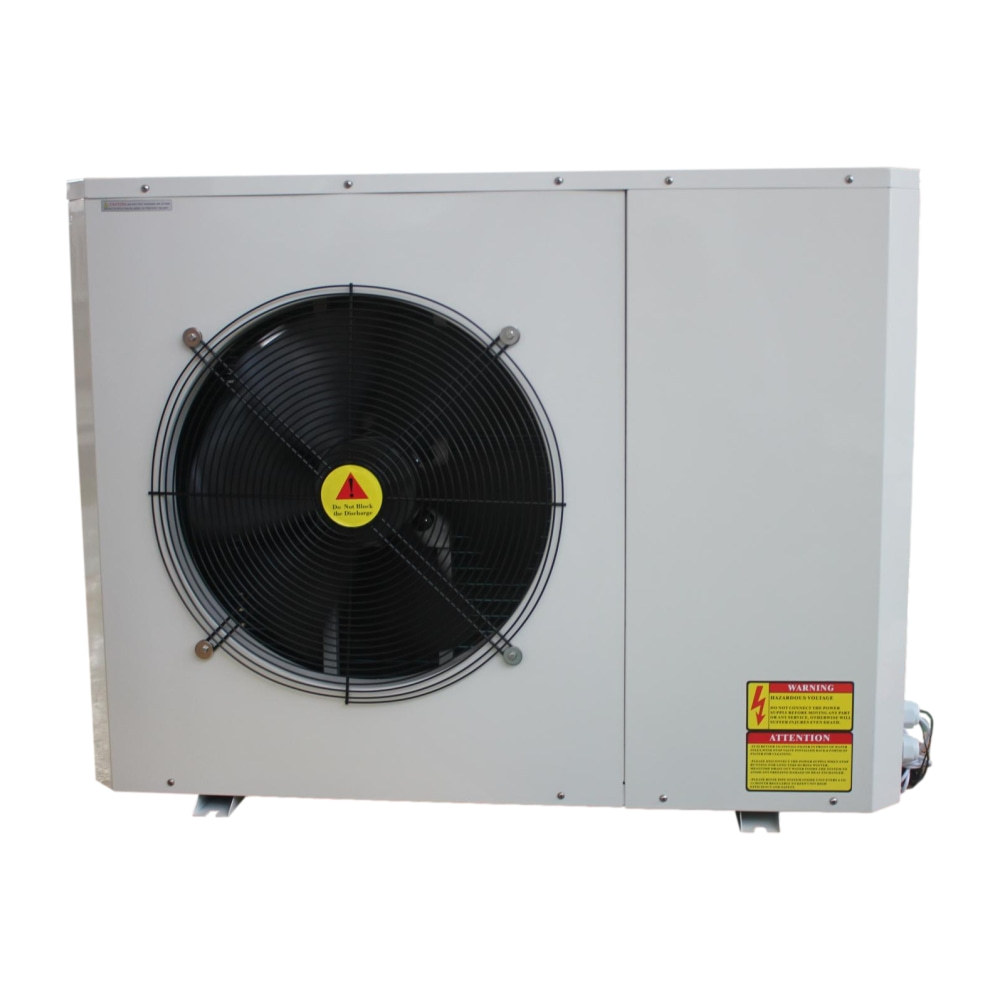
Featured Unit: SHAW-12EVIM 12 kW EVI Monobloc Heat Pump
- Model: SHAW-12EVIM
- Power supply: 380 V / 3-phase / 50 Hz
- Air flow: 3,250 m³/h
- Fan rated power: 90 W
- Use case: Cold-climate homes, light commercial heating and DHW
The SHAW-12EVIM is an EVI monobloc unit that passes enthalpy-lab testing at low ambient conditions. Its enhanced vapor injection circuit is assembled and charged on the same line as Suoher's standard inverter range, then routed to a dedicated low-temperature test station.
Learn MoreQuality Control System
Testing individual units is necessary but not sufficient. A quality system makes sure that every unit, every shift, and every supplier batch meets the same standard. Suoher's factory operates under an ISO 9001:2015 quality-management system with production-control procedures that cover incoming inspection, in-process checks, final inspection, and corrective action.
Incoming Inspection
Compressors, expansion valves, controllers, fans, and heat exchangers are sampled or fully inspected on arrival. Critical refrigerant components are checked for model code, batch traceability, and dimensional conformance. A wrong expansion valve in one batch can shift the refrigerant charge and degrade COP across an entire container.
In-Process and Final Inspection
Key stations record pass/fail data by serial number. Examples include coil nitrogen pressure test, compressor mounting torque, refrigerant charge weight, hi-pot voltage, leak-test result, and run-in duration. This data becomes the unit's birth certificate and is stored for warranty traceability.
| Check Station | What Is Verified | Typical Acceptance Criterion |
|---|---|---|
| Coil nitrogen test | Brazing integrity of heat exchanger | No pressure drop over 30 seconds |
| Compressor torque | Mounting bolt torque and anti-vibration | Within ±5% of spec |
| Refrigerant charge | Charge weight by model | ±10 g residential, ±30 g commercial |
| Hi-pot / ground test | Electrical safety | No breakdown at 1,500 V AC |
| Enthalpy lab | Capacity and COP at rated conditions | ≥ 98% of rated capacity |
| Run-in test | Infant-mortality screening | No fault codes or abnormal noise |
| Leak detection | Refrigerant circuit tightness | Zero detectable leak |
100% Testing vs. Sampling
Not every test can be 100% without making the product unaffordable. The standard trade-off is: safety-related and compliance-critical tests are 100% (hi-pot, ground, leak on flammable refrigerants, run-in), while performance verification is typically done on a sample per batch plus first-article inspection. Suoher adds extra sampling when launching a new model, changing a supplier, or ramping production after a holiday shutdown — the three moments when defects are most likely to slip through.
What Buyers Should Look for on a Factory Tour
Whether you fly to Foshan or join a virtual walkthrough, here is a practical checklist. If a factory cannot show you these things, ask why.
- Traceability: Can they pull the production and test record for a unit by serial number?
- Calibration: Are test instruments calibrated to national or international standards with valid certificates?
- Test lab independence: Is the in-house lab isolated from production pressure? Do they also send samples to third-party labs?
- Defect handling: Is there a clearly marked repair and rework area? Are failed units segregated?
- Change control: How are engineering changes communicated to the production line and documented?
- Packaging: Are units protected for sea freight, with corner guards and moisture barriers? A perfect unit can arrive damaged if the carton is wrong.
For a deeper dive into selecting the right manufacturing partner, see our earlier guide on how to choose a heat pump OEM/ODM manufacturer in China.
A Look at Suoher's Production Lines
Suoher's Foshan facility runs dedicated lines for residential DC inverter heat pumps, EVI low-temperature units, commercial air-to-water heat pumps, and swimming-pool heat pumps. The layout separates clean assembly from refrigerant charging and testing to prevent contamination and cross-traffic. Annual capacity is structured around modular cell production, which lets the factory scale individual lines up or down based on seasonal demand without losing tooling discipline.
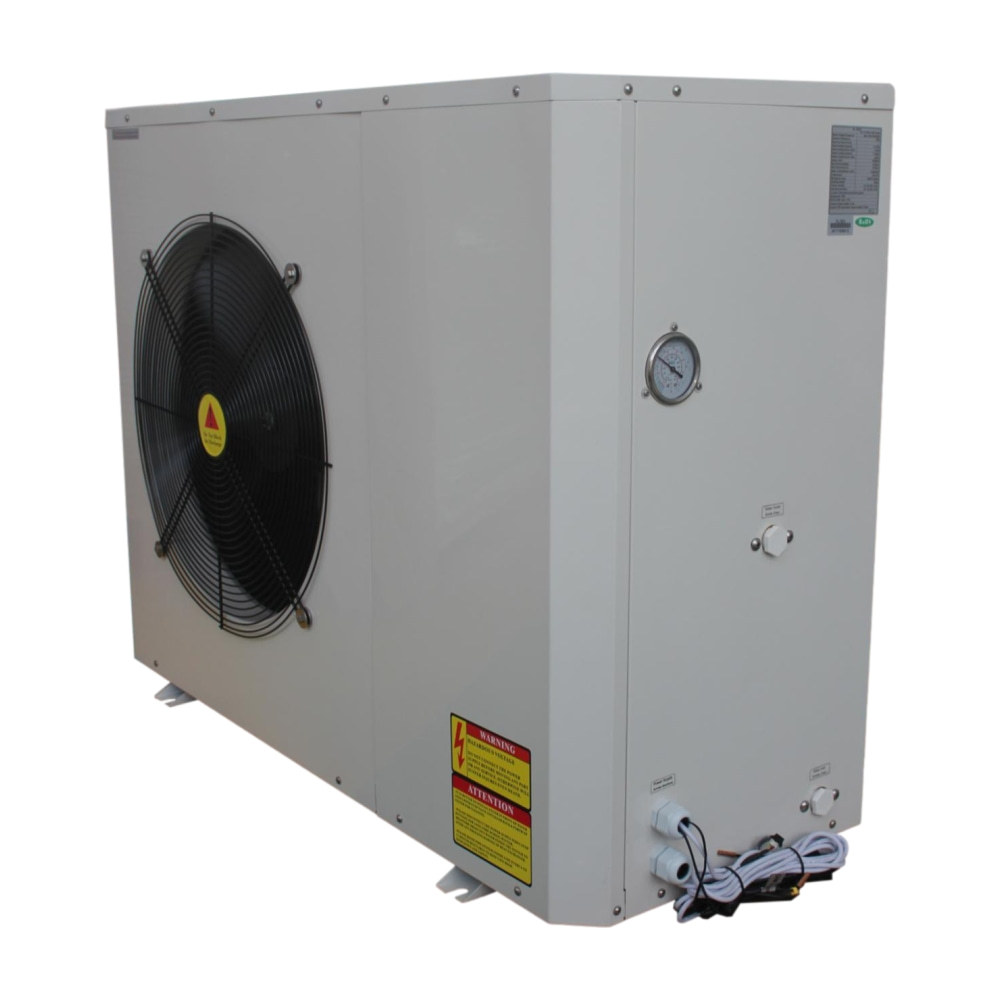
The Suoher SHAW-12EVIM in production: EVI monobloc units receive the same base assembly as standard inverter models, followed by a dedicated enhanced-vapor-injection circuit and low-temperature test station.
Key production capabilities include:
- Sheet-metal and cabinet fabrication in-house, so color, badge, and structural brackets can be customized for OEM orders without long lead times.
- Refrigerant circuit building with nitrogen-purged brazing and automated pipe bending to reduce joint count.
- Explosion-proof R290 charging station for the next generation of low-GWP units.
- Enthalpy laboratory with multiple test chambers covering air-source, water-source, and pool-heat-pump conditions.
- Aging and run-in room that can hold a full shift of production for simultaneous burn-in testing.
- Packing and container-loading area with custom foam and carton designs for long-haul ocean freight.
Because Suoher controls the full process from metal forming to final test, the engineering team can validate a design change in days rather than weeks. That responsiveness is what allows fast OEM sample turnaround and rapid certification updates.
Book a Virtual Factory Tour with Suoher
Factory discipline is the difference between a heat pump that delivers predictable savings and one that drains your service budget. If you are evaluating a new supplier, launching your own heat pump brand, or simply want to see how a modern inverter heat pump is built from coil to carton, Suoher's team can walk you through the production line, the enthalpy lab, and the QC stations — in person or by video call.
Request a Factory Tour & Sample Quote
You will come away with a clear picture of capacity, testing standards, and whether the factory can consistently build the unit your market expects. For buyers who cannot visit immediately, Suoher also provides production-record samples and third-party test reports so you can verify quality before the first container ships.